Showing posts with label Viagens. Show all posts

Wednesday, May 1, 2019

What to do in Arraial d’Ajuda – Bahia: Best Beaches

O que fazer em Arraial d'Ajuda - Bahia: Melhores Praias

Our trip to the Discovery coast, in Bahia, began in Porto Seguro and on the second day of travel, we went to Arraial D'ajuda.
Arraial D'ajuda is one of the best lodging options in this region. The best of both worlds, since it is not full of people as in Porto Seguro, but still more economical and accessible than Trancoso.
But our tip, for those who have more than 4 days of the itinerary in Porto Seguro, is to share their lodging. In this last script, we stayed 3 days in Arraial D'ajuda and 4 days in Trancoso. The idea is to try the places beyond a simple knock and turn.
We missed staying in Caraíva. There is always something left to do next time, but at least we can get to know through a hit-back from Arraial D'ajuda.
In this post, you will see how to get toArraial D'ajuda, the best options of restaurants and beach tents and still a roadmap for hiking through its best beaches.

 What to do in Arraial d’Ajuda – Bahia: Best Beaches

How to get there, where to stay and what to do in Arraial d’Ajuda

Arraial D'ajuda is one of the districts of Porto Seguro, still on the coast of the Discovery of Bahia.
The footprint in Arraial is a little quieter than in Porto Seguro, but still the night of Arraial is very lively.
By day, hiking is the best program in Arraial. Book two days to make them, proceeding to the two extremes. The two walks start from the beach of Mucugê, the most central beach of Arraial D'ajuda.
On one side, you follow to the mouth of the Buranhém River, which we made the crossing from Porto Seguro to arrive in Arraial. On the other hand, for the most willing, you can walk to Trancoso.
If your proposal is to sit and enjoy a good beach structure, we also recommend some tents there. Follow our tips.
O que fazer em Arraial d'Ajuda - Bahia: Melhores Praias
Visual of the Praia do extinguish-fire and the Buranhém River, which divides Porto Seguro de Arraial D'ajuda

Directions to Arraial D'ajuda

Ferry crossing

A ferry separates Porto Seguro from Arraial D'ajuda. On account of it, it is a little more expensive to take a taxi from the airport to Arraial (R $150.00). Uber then only played values above R $200.00.
As we had already anticipated this scenario in the blog of Ricardo Freire, we decided to spend a night in Porto Seguro. It was not at all bad, after all we enjoyed taking a walk on the catwalk of alcohol (or catwalk of discovery) and we still went to meet a very cool tent on the beach of Taperapuan (the Malibu hut).

How to circulate in Arraial D'ajuda: Vans and buses

Upon arriving at Arraial D'ajuda, some drivers come to offer the van service, which is OK, but we prefer to go by bus because of the suitcases. The bus left empty and gave us to settle quietly (R $3.50).
The fussy went down downtown and still walk about three blocks to our inn. But we could have gone by taxi, too.

It's worth renting the car

The offer of buses and vans is great, because of this we decided to dispense with the car rental.
To get down, every saint helps, but to climb back to the center, the deal picks up. Luckily, the vans also circulate there and offer the transport from the beach to the upper part of Arraial D'ajuda.
But all this is to say that if you travel with family or want to get off the beach with the utmost convenience and speed, the car is really the best option.

When to go

Visual of Praia do Taípe on a beautiful sunny day, one of the famous and beautiful of Arraial D'ajuda
Two things have already ruined a lot of our trip to Arraial D'ajuda.
  • Rain: In 2013, we went in the month of June, a month that, by our experience, was a lot of rain. It really messed up our trip, so much so that some days were totally lost.
  • Tide: The beaches of Arraial D'ajuda are more beautiful at low tide, when they form natural pools and the color of the sea gains more incredible tones. Check the Tide board and make sure you get down there.

In 2019, we went in the month of January and the tide, although it was not so low, allowed us to enjoy the trip better. And the sunny days were guaranteed.


What to do – nightlife and restaurants

O que fazer em Arraial d'Ajuda - Bahia: Melhores Praias
Mucugê Street, considered one of the most charming in Brazil
Practically everything in Arraial D'ajuda revolves around the Praça São Brás (where the Hippie fair happens) that unfolds in three poles of restaurants and shops.
The street Mucugê is the most famous, considered by many the most charming street in Brazil (has plaque there to remind visitors of this). A bit of exaggeration, of course, but the place is rather charming and charming, with several restaurants and cool bars to enjoy the night.
The Broadway Street (Rua Bróduei, officially St. Peter Street), on the other hand, is a more pleasant promenade to walk, but without much charm. Very little relationship with the name.
And finally the Praça Brigadeiro Eduardo Gomes (better known as Largo da Ajuda, in front of the Matriz Church Nossa Senhora D'ajuda) and is a charm, with several houses and colorful shops. It is worth remembering that behind the church has an unmissable lookout.

Colourful houses in the beautiful Praça Brigadeiro Eduardo Gomes, or Largo da Ajuda

Where to eat

Among the restaurants, we highlight the Naturalíssima, which is on Rua do Mucugê 175. In a small space that also works as a hostel, the exquisite service of the staff always gives tip of the best dishes.
The restaurant is vegetarian, but the executive dish is accompanied by several types of "burger", such as a lot of dirt, banana from the land or eggplant. Very tasty and very cheap (R $21.00 the executive dish, ref: Jan/2019).

The Vegetarian Restaurant Naturalíssima offers dishes for just over R$20.00
In the Caminho do Mar square, also in Rua do Mucugê, a Largo gathers several bars, restaurants and cafeterias around a stage with live music. In the center a fountain and some benches for the staff to settle.
The warehouse of the square is the best restaurant option, with a boteco atmosphere and delicious and well served gourmets dishes (the Galeto costs R $56.00 and serves two people well).
Stay connected also to the alley of colors, a charming small alleys with some options of bars, shops and restaurants.
For dessert, the hint is the ice cream. The most famous ice cream parlor is the Bunny ice cream shop, but we prefer self service sorvets and we love D'gusti (the Nutella icecream and the toppings are delicious). Stay tuned that on Tuesdays and Wednesdays was rolling promotion, with 50% discount on the kilo.

What to do in Arraial D'ajuda

Tours with tour agencies

Arraial D'ajuda may be the best alternative to make tours around the region. Instead of Trancoso, where the offer of Tours is restricted (not to mention non-existent), in Arraial D'ajuda There are several tour agencies.
If you are in Porto Seguro, you have to face the ferry crossing to reach the best beaches of the Discovery coast.
In Praça São Brás, in front of the tourist information kiosk or on the street of Mucugê itself, you can find some of them. The prices of the tours cost on average R $80.00 and the vans seek the passengers in their inns.
Among the options, you can go to Praia do Espelho, to the beach of Caraíva or to Porto Seguro. The Arraial Trip Tour and Portal Turismo are some tourist agencies that we have already tested and approved.

Church of Our Lady of Help

Church of Our Lady of Help, historical and religious importance
The Church of Our Lady of Ajuda was erected in 1551, in tribute to Tomé de Souza and the first Jesuits who arrived on the site in three naus: Conceição, Salvador and Ajuda. The name of the Naus inspired the name of the church.
This is the first sanctuary in Brazil. He housed the image of Our Lady of Ajuda, who arrived in the region in 1549. Since its construction, the church has undergone several adaptations.
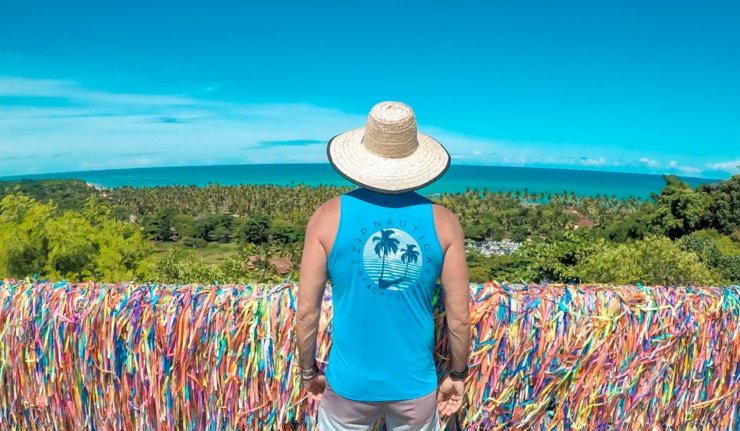
In addition to the history and religious importance, the church hides one of the best sights of Arraial D'ajuda. Behind it, the lookout for the sea is spectacular and still has the additional to be illustrated by a multitude of colorful ribbons. The photos are amazing.

Mucugê Beach

On the way down Rua do Mucugê, we arrived at Mucugê Beach.
The arrival is not very pleasant and is all too squeezed. The tents lack charm, but the beach is beautiful. At low tide, it forms a large natural swimming pool, of calm and warm waters.
The descent is quite steep, so you can already suffer in anticipation for the ascent, but the good news that there are vans that make the route from the center to the beaches (R $5.00). There are also vans for Pitinga beach.
One of the best tents options is La Plage.
O que fazer em Arraial d'Ajuda - Bahia: Melhores Praias
Praia do Mucugê is the most central and bustling of Arraial D'ajuda

Hike to the north coast

On the first day, we walked to the left side. For every walk, it's good to look at the tide board. Our walk began at 10am, at the highest peak of the tide (so we were quiet because there would only download).
In the first stretch, at the height of the Arraial Eco Resort Aquatic Park, there is a higher stretch where you can walk quietly, even at high tide. This excerpt ensures that the walk can be made at any time.

Fisherman's Beach

After that, we arrived at Fisherman's Beach, which actually has fishermen's boats.
The beach is more extensive and quiet than Mucugê, and has a beautiful coconut grove. The excess of Sargasse has bothered us a little but we like the beach anyway.
But if you're looking for infrastructure, it's not your beach. There are few beach tents there.
O que fazer em Arraial d'Ajuda - Bahia: Melhores Praias
Visual of Fisherman's Beach of the high

Araçaípe Beach
O que fazer em Arraial d'Ajuda - Bahia: Melhores Praias
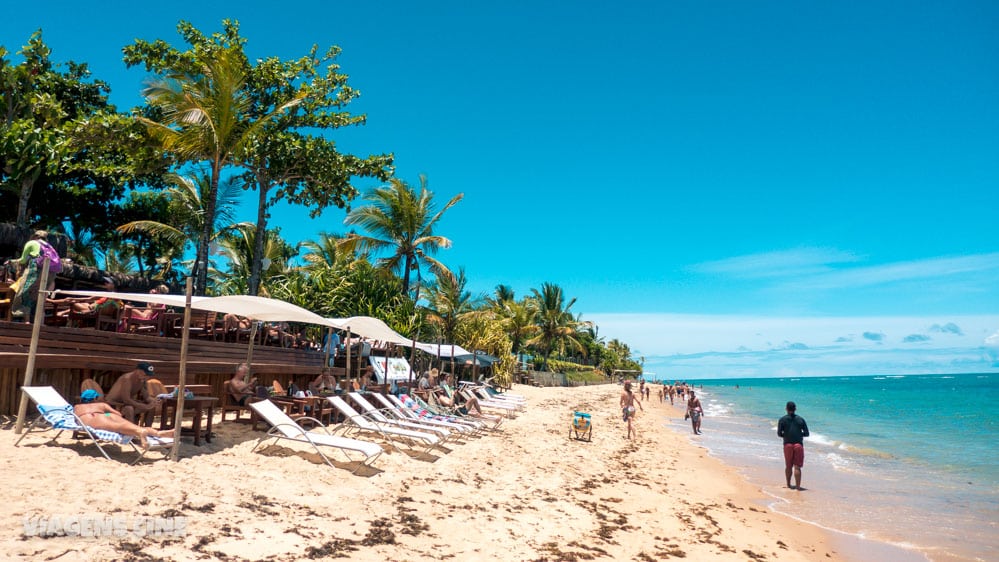
More stylish beach tents in Aracaípe beach
On the way, the beach tents started popping up on Araçaípe beach.
This is where the tents Sting and Corujão are located, two of the most famous of Arraial D'ajuda. They are well decorated tents, with several sun loungers in front and minimum consummation collection (prices vary according to the time of year).
You can arrive by car quietly, are about 10 minutes from the center (3 km away).

Erase Fogo Beach

O que fazer em Arraial d'Ajuda - Bahia: Melhores Praias
A large natural and shallow pool can be found in the Praia do Extingufogo, one of the extremes of Arraial D'ajuda
We follow the hike to finally find the Praia do Extingufogo. Arraial D'ajuda literally finishes, and it is possible to see the tip of the beach, which finds the mouth of the river Buranhém.
The name of the beach would originate from a fisherman's habit, leaving a lighted lamp on the way out to fish. On the way back, the lamp was erased. In case any of them remain lit, the other fishermen would know that some of their colleagues could not return.
But the biggest attraction here is another natural swimming pool, quite frequated by the small and the structure of Arraial D'ajuda Eco Resort.
The route lasts about 1 hours for those who will walk without stops. We took 2 hours, with stops to dive and to climb the drone.
And here is the hint: you can even make the return on foot, but we prefer to take a bus back to the center. From the beach, there is a alley (seems a little suspicious, but follow it) that flows directly on the ferry from Arraial D'ajuda. The transport offer is great.

Hike to the south coast

This walk follows in the direction of Trancoso. Around here, we have already commented on a hike we made, at low tide, to the village of Trancoso. It's an unmissable program, but it requires a lot of disposition.
As the tide was not so low and the heat of January merciless, our last time we could not repeat this path.

Parracho Beach

Praia do Parracho has more sophisticated and beautiful tents than in Mucugê
This is the first beach walking from Praia do Mucugê to the right side. There's not much difference between the two, so it gets hard until you know where one ends and the other begins.
But an important reference is the Uiki Parracho, the most famous and charming beach tent in the region. The minimum consummation is about R $100.00 per person (the value varies according to the time of the year, Day of the week or even the stocking of the place).
Another well-respected tent is the Cabana Grande, which does not charge consummation. But it's good to be early, because the tent tends to get crowded.
It was from Parracho beach that we did a very cool Hawaiian canoe activity. Who gives the class is Cauê, @cppextreme instructor. The sports activity is performed by residents of Arraial D'ajuda, but you can contact and participate in a class. It's two hours daily, very early.

Hawaiian Canoe Crosses some of the reefs of the beaches of Arraial D'ajuda
In addition to the paddles, there is also a stop for snorkeling in the sea with a lot of marine life. After the canoe, we were still enjoying our last moments in Arraial.
With the tide still low, we walk through the beaches of Parracho, Pitinga and Lagoa Azul. Very early walk, we find empty beaches and a delight in the morning.
At 10am we were back at the inn to have breakfast. Sometimes it's good to start the day in a totally different way, right?

Pitinga Beach

O que fazer em Arraial d'Ajuda - Bahia: Melhores Praias
Visual of Praia da Pitinga, considered by many the most beautiful of Arraial D'ajuda
A little bit of good is Pitinga beach. It is very easy to recognize, because soon when you arrive you come across a look of the cliffs and several restaurants standing on the sand.
If you want to go straight to the beach, there is a parking nearby and the vans also leave on site.
As the offer of tents is higher, the prices are more inviting than in Praia do Parracho, but in return also loses a little charm.

Blue Lagoon Beach

Almost deserted and paradisiacal, Praia da Lagoa Azul is a must-have program
Continue walking along Praia da Pitinga beach to get to Lagoa Azul beach. This is one of the stretches that you can really only do at low tide.
In this stretch the beach is totally wild and there is only one beach tent, the Cabana Lagoa Azul, with a rainbow flag. Love. But since we were pretty early, she wasn't open yet.
The Blue Lagoon that gives the name to the place was a pond even (the first time I visited I remember that it had even a cascade that went down in the gorge between the cliffs). Unfortunately, the waterfall and pond dried up.
But walking a bit into the span between the cliffs, it is possible to find a point where it is still possible to smear with mud. I don't know if you believe in the therapeutic power of these clay baths, but it's always fun to take some pictures.
There also has a very complicated access, but it can climb to the top of the cliff and have a beautiful look of the region.
It is the perfect place for those who want a deserted and wild beach.

Taípe Beach

O que fazer em Arraial d'Ajuda - Bahia: Melhores Praias
Taípe Beach and its cinematic cliffs
From the Blue Lagoon, begins a large expanse of sand, with high cliffs. The beach is very beautiful, but it is a long stretch of desert, except for an access stretch of Club Med Trancoso (a famous resort of the region).
If you want to come by car, there are 30 minutes of dirt road, from the centre of Arraial D'ajuda.
The Taípe Hut is a point of support of groups (because of this it gets fuller and without much tranquility). This beach point has easy access by car. Next door There is also the Cliff hut.
There is no minimum consummation charge, but parking costs R $15.00 (ref. Jan/2019).

Credits: viagenscinematograficas

What to do in Porto de Pedras: Beach of Patacho and Peixe-Boi – Alagoas

Praia do Patacho, association Peixe-Boi, Praia de Lages, all these attractions of the ecological route of Alagoas are in the municipality of Porto de Pedras. But a lot of people refer to them as if they were part of São Miguel dos Milagres, a neighboring city.

But let's give the right places a merit. Porto de Pedras is already an emancipated municipality since 1921. In fact, the Centrinho of Porto de Pedras is very simple but much more charming than the village of São Miguel de Milagres or Porto da Rua. I felt like staying there.

And what about the colourful village of Tatuamunha? Nearby is the Peixe-Boi Association, place of one of the most crowded and peculiar tours of the region.

The lighthouse of Porto de Pedras is seen from several places and is on the banks of the river Manguaba, which separates Porto de Pedras and Japaratinga. From the top, the view (somewhat improvised) is an attractive one more.

What to do in Porto de Pedras: Beach of Patacho and Peixe-Boi – Alagoas

Meet this city next to São Miguel dos Milagres that brings some of the most beautiful beaches of Alagoas

Porto de Pedras is another of these amazing destinations on the north coast of Alagoas. Beaches, ecological tours and good restaurants are some of the options between what to do in Porto de Pedras.

For those who come from Maceió, you must cross the ecological route until you get here. On the way, we cross destinations such as Paripueira, Passo de Camaragibe (from Barra de Santo Antônio you need to make a small detour to the interior) and São Miguel dos Milagres. The journey lasts about 2:30 a.m.

Crossing the Manguaba River

Who arrives from Recife, Maragogi or Japaratinga, you must cross the river Manguaba by ferry and arrive in Porto de Pedras. The path across the river is already a stroll. While we are approaching the city, the landscape is complete with the lighthouse, symbol of the city and located on top of a hill.

When the ferry slopes in the fields of Porto de Pedras, it is possible to find a quiet city with colourful houses, children playing on the street and the water of the river Manguaba as scenery.

Lighthouse of Porto de Pedras

It is worth climbing a steep slope and arriving at the top of Porto de Pedras, where is your lighthouse. We were on foot, because we had read an alert from the Gleiber of the world Wanderers that there was not much room to park up there.

The truth is that the entrance to the lighthouse itself is controversial. There's a navy warning saying the entrance is forbidden, but a huge open gate. What to do??? A boy was sleeping at the base of the lighthouse and he calls us to show a lookout. From a few different points, you can view the nearest beaches.

Through the trees, you can see the waterfront of Porto de Pedras and the amazing way the water of the river touches the seawater, well verdinha. The colors alternate in a beautiful landscape.

The boy still talked a little bit about some curiosities of the place and showed a painting inside the lighthouse.

The lighthouse is 90 meters high and was inaugurated in 1933.

At the end of the day, the view of the lighthouse of Porto de Pedras is beautiful, but the place is somewhat improvised and is somewhat uncomfortable this situation of the forbidden entrance. Just visit if you have time left.

Patacho Beach


After the visit to the lighthouse, we descend and follow to the biggest attraction of Porto de Pedras: the Patacho beach.

This beach has already been considered one of the most beautiful beaches in Brazil. Judging by our visit, I consider this rating super esteemed, but the beach is really beautiful.

It turns out that we visited Alagoas in September, after a long period of rainfall. In the month of July it had rained practically every day there and until September the rains were still frequent. Perhaps that's why the water was cloudy and not as crystalline as one expects from a destination with the fame of being the Brazilian Caribbean.

We also found a lot of dirt in seawater, including human garbage. It is no wonder that the government of Alagoas placed on all the beaches the following message: The beach is ours, the trash is yours.

How to get there

Anyway, we visited Patacho beach in two moments of the day. Access is easy, just take the path that has the Patacho post on the corner.

The road is ground but it can circulate normally, and arriving on the beach has plenty of place to park.

There is no structure, so it is good to bring drinks and who knows something to eat, depending on the time you will stay. But don't forget the trash, huh?

At first, we find Patacho with low tide, with water in shades of green and turquoise blue. You could walk to the corals, or opt for a Jangadeiro (around R $40.00 per person). As the water gets very shallow, this moment is not very conducive to those who like to swim or dive.

We'll be back later with the full tide. There, you can get the adults to enjoy the sea and the sand strip is more beautiful, with the coconut trees closest to the Caribbean color waters. Looks like two different beaches.

Laje Beach (or Lages beach)


Another beach that is worth the visit is the Laje beach (many people write Lage or Lages beach, but the writing of the correct word, according to the dictionaries, is with the letter "J").

The arrival impresses, through a huge plantation of coconut trees. The access by the road was very muddy, we were very afraid to jam and stopped just before arriving at the beach.

The beach holds the same characteristics as Patacho, with the difference being in Half moon format.

At the entrance, two kiosks guarantee drinks and coconut water.

Tatuamunha and Peixe-Boi Preservation Project


Finally, it is not enough to leave out the beautiful village of Tatuamunha, with historic mansions and the visit to the Peixe-Boi Association.

The village has charming houses and squares, and a small church, the Church of São Gonçalo.

How much it costs and how to book the tour to see the manatee

The tour to see the manatee can be scheduled by WhatsApp (Peixe-Boi Association (82) 99359-7473).

It is advisable to reserve as there is a limit of people per day. And so you also guarantee the time of your preference.

The price is a little salty, in my opinion. It costs R $50.00 per person and includes the guide and a tour of about 1 hours. The boat follows until near a breeding of manatees, where they re-adapt to nature.

The value ends up compensating to encourage a beautiful project. A group of community guides have joined together to help preserve manatees in their natural habitat and order observation tourism. The project is part of the APA Costa dos Corais, which guarantees the preservation of the north coast of Alagoas.

Manatee is the most endangered species of aquatic mammal in Brazil, classified as "in critical Danger" since 1989 (MMA, 2010).

The project generates income for more than 40 families, besides helping to preserve the species. Therefore, face the value of the tour as an investment in this beautiful initiative.

How the Tour works

The management plan allows minimal interaction, so everything you do on the raft is approaching the animals. When they appear, you can stay close to them, but touching is not allowed under any circumstances. In some cases, it may be until they lean over the raft, but it didn't happen to us.

According to our guide Carla, the months of June and July, for being colder, are when the manatee gives fewer faces. In these situations, he prefers to be under the water himself. You know that little chill you got when you get out of the sea?

As our September was also not of the hottest, we can only see the queer emerge from time to time to breathe out of the water.

Tatuamunha Beach

There was no time for us, but you can still get to know Tatuamunha beach.

It is there that lies the mouth of the Rio Tatuamunha, the same where the tour is done to see the manatee. The place is also known as Boca do Rio and one of the currencies of the municipality of Porto de Pedras. After the river, we are already in Porto da Rua, in São Miguel dos Milagres.

Credits: viagenscinematograficas

Porto de Galinhas and Maragogi: Route Alagoas and Pernambuco – Costa dos Corais


One of the most beautiful stretches of the Brazilian coastline, many people are betting on a roadmap of a car trip that starts in Maceió or Recife and passes through destinations like Maragogi, Porto de Galinhas and Praia dos Carneiros.

This script is really unmissable, as it combines some of the best destinations in Brazil. The ideal to explore the various sights of Alagoas and Pernambuco located on this route is at least 7 days. There's a lot of cool stuff to know.

The region includes a stretch of the coast of Pernambuco and Alagoas known as the coast of the corals and is part of an environmental protection area, the APA Costa dos Corais that starts at the mouth of the River Formoso (Tamandaré/PE) and goes to the Meirim River (Maceió/AL). There are about 120 km of beautiful coast of Brazil.

As the beaches are protected by coral reefs, which at low tide create natural pools and provide warm water and greenish coloration, the region is often called the Brazilian Caribbean.

In this matter, we will identify what are the 10 attractions and unforgettable sights for those who visit the region. And also help you not leave anything out in this itinerary of travel along the coast of Alagoas and Pernambuco.

Maragogi, Porto de Galinhas and Praia dos Carneiros: Places to meet on the Coral Coast

What to do in a car route from Maceió to Recife: Alagoas and Pernambuco

Our itinerary begins in the state of Pernambuco, but you can make the itinerary starting in Maceió. The order of the destinies does not interfere with the tour.

In this first part of the script, you go straight to Porto de Galinhas. The length of stay there depends on the number of days you have in your itinerary. Let's set up some simulations for 7 days or 15 days of travel.

To make this itinerary, we recommend renting a car, which will give more mobility to know all the destinations.

But it is also possible to make this script without car. In this case, the tip is to rely on the support of local tour companies. In Porto de Galinhas, we recommend the services of the Sol & Mar Tour.

 Is it worth renting a car?

The best way to make this script is by car, because it gives you more autonomy to define the stops and the length of stay in each place.
  • The price of a car rental for 7 days costs on average R $100.00/day for withdrawal and return in the same city.
  • The ideal for this script would be to remove the car in Recife and return it in Maceió (or vice versa). But in this case, the rent price rises to R $150.00/day. That is, the difference is more than R $300.00 to return the car in another city.
  • The journey time between Maceió and Recife is about 4 hours of road. So you need to evaluate what is most advantageous to you: Save the R $300.00 or save 4 hours of road and return the car to another destination.
  • In general, it is easier to find cheap airline tickets to Recife than to Maceió. Therefore, our recommendation is to start the itinerary in Pernambuco (if you choose to return the car at the same location of the withdrawal).

Part 1: Porto de Galinhas and Praia dos Carneiros – Pernambuco

  • If you have 15 days to make this itinerary between Recife and Maceió, we recommend at least 5 nights in Porto de Galinhas.
  • Although it is possible to get back from Porto de Galinhas to Carneiros Beach, many people enjoy the experience of staying there. But it is worth noting that the place has no nightlife and the feeding options are limited. See if your hostel has a restaurant and full board.
  • For a 15-day itinerary, it is worth booking 1 night for Carneiros Beach.
  • For those who have only 7 days of travel, we recommend 3 nights in Porto de Galinhas and make a stop at Praia dos Carneiros on the way to Maragogi.

Route Recife to Maceió – Day to day

Next, follow the option of a route for those who have 15 days of travel.
  • Day 1: Arrival in Recife, withdrawal of the car at the video store and go straight to Porto de Galinhas. Overnight in Porto de Galinhas.
  • Day 2: Porto de Galinhas: End-to-end Buggy ride and natural pools. Overnight in Porto de Galinhas.
  • Day 3: Porto de Galinhas: round trip to Santo Aleixo Island. Overnight in Porto de Galinhas.
  • Day 4: Porto de Galinhas: Tour to Recife and Olinda. Overnight in Porto de Galinhas.
  • Day 5: Porto de Galinhas: round trip to Cabo de Santo Agostinho. Overnight in Porto de Galinhas.
  • Day 6: Check-out and depart for Praia dos Carneiros. Overnight at Carneiros Beach.
  • Day 7: Departure to Maragogi. Overnight in Maragogi.
If you have only 7 days of travel to the complete itinerary, follow our suggestion of roadmap.
  • Day 1: Arrival in Recife, withdrawal of the car at the video store and go straight to Porto de Galinhas. Overnight in Porto de Galinhas.
  • Day 2: Porto de Galinhas: End-to-end Buggy ride and natural pools. Overnight in Porto de Galinhas.
  • Day 3: Porto de Galinhas: Tour around the island of Santo Aleixo or Recife and Olinda. Overnight in Porto de Galinhas
  • Day 4: Departure to Maragogi with stop to spend the day in Praia dos Carneiros. Overnight at Maragogi.

1 – Porto de Galinhas – raft ride to the natural pools


  • Porto de Galinhas is the paradise of natural pools.
  • Yes, we really like natural pools. And the natural pools of Porto de Galinhas are unreadable. Unlike the pools of Maragogi (accessible through a catamaran tour), these are close by, even to go walking (at low tide).
  • But the best program is the raft ride. They color the scenery of the beach (although sometimes they spoil the scenery with the excess of advertisements). To attract the fishes, some jangadeiros provide food for fish.
  • One option is to dive with cylinder, but sincerely our experience was not very positive. But as the value is relatively inexpensive, it may be an opportunity for you to experience the business if you have never done so.

Tip: The raft ride takes 45 minutes at 1:30 a.m. There is a kiosk of the Janganers Association, on the main street of Porto de Galinhas, in front of the beach. Checking the Tide board is essential, but reserving in advance is not necessary.
How much does it cost: R $25.00. Diving equipment and fish feed can be charged separately. I recommend buying a snorkel and scuba mask soon, since you are not sure whether these rented equipment are properly sanitized.

2 – Porto de Galinhas – Praia de Muro Alto and Pontal de Maracaípe


  • Muro Alto Beach is my favorite corner in Porto de Galinhas. Again it is a natural swimming pool par excellence. Calm down, you're not going to get seasing in so many natural pools.
  • The reef in Muro Alto is well defined (so the name of the beach), so it is possible to walk through it (do not forget the sandals not to hurt the feet). Between the beach and the "wall", a large and delightful swimming pool, perfect for example to go kayaking quietly.
  • It is on the beach that you can find some of the best hotels in Porto de Galinhas, most of them for couples and families. Because of these hotels and resorts, access to the beach can be a little difficult.
  • At the opposite end of Porto de Galinhas is the Pontal do Maracaípe, perfect place to take a raft ride, see Sea horses and enjoy the sunset.
  • The best way to get to know the two beaches on the same day is to make a buggy ride from end to end.
Tip: The beach is 8 km distant from the center of Porto de Galinhas. You can even walk (on the way is the Cupe beach), but it is very far. Better even go buggy or take a taxi or Uber. The Maracaípe beach is closer and you can walk, but also to buy time, you can go by car, taxi or Uber.
How much it costs: The Buggy ride costs R $200.00 to R $250.00 for up to 4 people and also stops at Pontal do Cupe, in the centre of Porto de Galinhas and in the Coqueiral de Maracaípe.

3 – Tour to the island of Santo Aleixo


  • To get to the island of Santo Aleixo, you need to drive to Barra de Sirinhaém. This is a round trip that can be made from Porto de Galinhas.
  • From Barra de Sirinhaém, speedboat rides to the island. Who operates this script is the Monteiros Tour.
  • The place has no infrastructure, but some beautiful natural pools and wild beaches to explore.

Tip: It is important to schedule the tour in advance and arrive early in Sirinhaém. The sooner you arrive, the more time you will have to enjoy the island.
How much it costs: the boat ride to Santo Aleixo Island costs R $60.00 per person, from Barra de Sirinhaém. To get there, you can go by car or hire a transfer from Porto de Galinhas (R $200.00 for up to 4 people with the Sun and Sea Tour).

4 – Praia dos Carneiros


  • The Carneiros beach today is much more than a hit-back from Porto de Galinhas. There are a number of lodging options there.
  • As we have already said, if you have a 15-day script, it's worth a overnight stay there. If you have 7 days or less, just spend the day there.
  • Among the great attractions of the place are the super tranquil and paradiduacal beaches, full of coconut trees, and the natural pools formed at low tide. A catamaran tour is also offered in Carneiros.
  • The most famous point of support to enjoy the beach is the Bora Bora restaurant. Other less crowded options are the Beijuripá and the Mustako.
  • A small church is well facing the sea, the chapel of São Benedito, completing the paradisiacal scenery.
Tip: Although the Bora Bora restaurant is the most crowded, it is also the best structure and with the best location.
How much does it cost: the parking price in Bora Bora is R $30.00 per car. Who arrives by taxi or transfer does not need to pay anything. To get there, you can go by car or hire a transfer from Porto de Galinhas (R $200.00 for up to 4 people with the Sun and Sea Tour). The catamaran ride, optional, costs R $50.00 per person.


Part 2: Maragogi, Japaratinga and São Miguel dos Milagres, Alagoas

  • If you have 15 days to make this itinerary between Recife and Maceió, we recommend at least 7 nights in Alagoas.
  • The most recommended destinations to choose a lodging are Maragogi, Japaratinga (with cheaper options of inns), Porto de Pedras or São Miguel dos Milagres.
  • For those who have only 7 days of travel, it is advisable to choose only one of these destinations and make tours to the neighbours.
Next, follow the option of a route for those who have 15 days of travel.
  • Day 7: Arrival in Maragogi. Overnight in Maragogi or Japaratinga.
  • Day 8: Natural pools of Maragogi and beaches of the north coast of Maragogi. Overnight in Maragogi or Japaratinga.
  • Day 9: Beaches and natural pools of Japaratinga. Overnight in Maragogi or Japaratinga.
  • Day 10: Road and beaches of Porto de Pedras. Overnight in Porto de Pedras or São Miguel dos Milagres.
  • Day 11: Beaches of São Miguel dos Milagres and Praia do Marceneiro. Overnight in Porto de Pedras or São Miguel dos Milagres.
  • Day 12: Departure to Maceió with optional stop at Broken car beach or Ipioca beach (Hibiscus Beach Club). Overnight in Maceió.
  • Day 13: Beaches of Maceió. Overnight in Maceió.
  • Day 14: Round trip to Barra de São Miguel and Gunga Beach. Overnight in Maceió.
  • Day 15: Return to Recife or departure from Maceió.
If you have only 7 days of travel to the complete itinerary Alagoas and Pernambuco, follow our suggestion of script for the passage in Alagoas.
  • Day 4: Trip from Porto de Galinhas to Maragogi with stop to spend the day in Praia dos Carneiros. Overnight in Maragogi or Japaratinga.
  • Day 5: Natural pools of Maragogi and beaches of the north coast of Maragogi. Overnight in Maragogi or Japaratinga.
  • Day 6: Road to Maceió, with stops in Porto de Pedras or São Miguel dos Milagres or go straight to the capital. Overnight in Maceió.
  • Day 7: Return to Recife or departure from Maceió.
As you could imagine, in 7 days this script is quite rushed and ends up not giving time to know most of the beauties of the region.

5 – Beaches of Maragogi


  • The main beaches of Maragogi are: Burgalhau, Barra Grande, Antunes, Ponta do Mangue and Peroba (towards Porto de Galinhas) and São Bento and Camacho (direction Japaratinga).
  • By walking the road from Pernambuco, you can already choose to make some stops on the way. The first beach, closest to the border of the states, is the beautiful beach of Peroba.
  • The most beautiful stretch of this coastline lies between the beaches of Antunes and Ponta do Mangue. Among them is the beach of Xaréu, also known as Praia da Bruna (a tribute to Bruna Lombardi).
  • On the beach of Pontal do Maragogi is where you find the best infrastructure. There is also the point of support for major tourist operators: avoid if you are running away from a lot of movement.
  • In São Bento, a legal program is to know the factories of gum biscuits (a species of Sequilho), traditional in the region.

  • From these beaches, it is also possible to make trips to smaller natural pools, such as the pools of Barra Grande and the barrier of Peroba. It's usually cheaper than going up to the galleys and taocas and much more empty.
  • The dimensions of these pools, however, are smaller and much more modest than galés.

6 – Galés – Walk to the natural pools of Maragogi


  • Probably the best attraction of the whole region is to take a catamaran and follow 6 km inland Sea (about 30 minutes by boat) to find the natural pools. In Alagoas, they are called galleys or taocas.
  • After the catamaran follows so long sailing, we stop at a place where it is possible to walk in the sea quietly (at low tide, worth remembering) and snorkeling to see the fishes. The color of the sea is impressive. 
  • The natural pools are part of the Environmental preservation area – APA Costa dos Corais, which aims to preserve the marine flora and fauna. As you can already imagine, the ecosystem is delicate and demands care to remain preserved, even more with the enormous amount of people who visit the pools daily.
  • Do not touch or walk on the corals, only in the stretches of sand.
Tip: The time of the tour depends on the Tide board. Please inquire at the location on the departure hours.
How much does it cost: The values cost from R $65.00 per person. If possible book in advance.

7 – Japaratinga


  • Japaratinga is next to Maragogi and guard as a similarity to the beaches full of coconut trees and paradisiacal landscapes.
  • The Centrinho is very modest, but there are some good lodging options, such as the Pousada do Alto.
  • At low tide, it is possible to walk a long sea inside, without you sinking. It's not exactly a natural pool, because you don't see the edges of "this pool", but it's very shallow and you can enjoy it like a swimming pool.
  • In Japaratinga There are also raft rides to natural pools.


  • If you are coming from Maragogi, there are several stretches where you stop. Whether in the center of Japaratinga, or a little further on Bitingui beach.
  • From there, the path follows to the barrier of Boqueirão, another point with some restaurants and in the end you reach the river Manguaba, which divides Japaratinga from Porto de Pedras.
  • We did this whole stretch on foot, but it is possible to go by car or also "hitchhiker" paid in Mototaxis.
How much it costs: the ferry crossing from Japaratinga to Porto de Pedras costs R $15.00 per car.  Pedestrians have free access. On days of movement, the crossing can take 1 hours, so the alternative is to go inland, via Porto Calvo.
Tip: Also look for a few sights from the top to check the scenery view from above (the look of the Pousada do Alto is unmissable). You'll admire a multitude of coconut trees and the green Sea of the beaches: it's an unforgettable setting.

8 – Porto de Pedras and the tour to see the manatee


  • At the end of Japaratinga, we find the river Manguaba, which can be crossed by ferry. On the other side of the river is the picturesque Porto de Pedras.
  • The Google Maps path indicates the path through an internal road, which is an alternative to the most moving days. The ferry is small and the wait on the crossing can last about 1 hours.
  • The great highlight of Porto de Pedras is the lighthouse, with a view of the river and the beaches. Better leave the car at the base and walk up.
  • The region is also known for the tour to see the manatee. Learn more at the Peixe-Boi Association website.
  • The proposal of the Peixe-Boi Association is the tourism of observation, which generates income for the local population and also stimulates socio-environmental education. Manatee is the most endangered aquatic mammal in Brazil.


Tip: The small town of Porto de Pedras is a lonely peace. Looks like you went back in time. Take a moment to relax and enjoy a climate of inner city, only by the seaside.
How much it costs: the ride to see the manatee costs R $50.00, but it is not guaranteed that the pet is seen. Anyway, the tour is enjoyable and allows you to see the habitat and get to know the project, although the price is not of the best. Book in advance.

9 – Patacho Beach and the ecological route


  • Often this beach enters the list of the best beaches in Brazil. It is one of the few that earn 5 stars of the Four Wheels guide, for example.
  • Praia do Patacho is part of the municipality of Porto de Pedras, although there is confusion and have those who include it as part of São Miguel dos Milagres.
  • The thing is that it is located on the road called Ecological route, which runs through this stretch of enchanting beaches on the coast of Alagoas.
  • The ecological route has attracted a number of travelers looking for the most reserved and private beaches and charm lodgings. So staying there goes more expensive.

Tip: Try to go at low tide to see some natural pools. The color of the sea also gains more beautiful shades as a function of the contrast between sea water and reefs.
How much does it cost: The value of a daily in the region leaves around R $200.00 to R $300.00. You can find some places to enjoy a pool in a day-use scheme.

10 – São Miguel dos Milagres


  • The ecological route and the Coral Coast follow two more destinations that follow the same scheme of Porto de Pedras: Secluded places, with charming inns and deserted and paradiseacal beaches.
  • In São Miguel dos Milagres, the highlights are for the beaches of Barra do Camaragibe, Praia do Marceneiro, the creek, Praia de São Miguel dos Milagres, Praia do Toque, Porto da Rua and Tatuamunha.
  • Here there are also raft rides to the natural pools (we did the tour from the beach of São Miguel dos Milagres), which are much quieter than those of Maragogi.


Tip: Despite being many beaches, here the thing is not to seek to know all but choose one to relax and enjoy well. The proposal here in the region is the isolation and relaxation in the natural pools formed at low tide, and they all possess with praise.
How much does it cost: There is no fee for visiting the entire APA – the Coral Coast Environmental Protection area.  Raft rides or tours to see the manatee, obviously, are paid for they involve the work of the local population.

Credits: viagenscinematograficas